
Where London's Best Clothes Go
London is not a cheap place to dress well. What it has is supply: samples, press-office clear-outs and designer wardrobes all have to land somewhere. Third Row Thinking follows the trail.
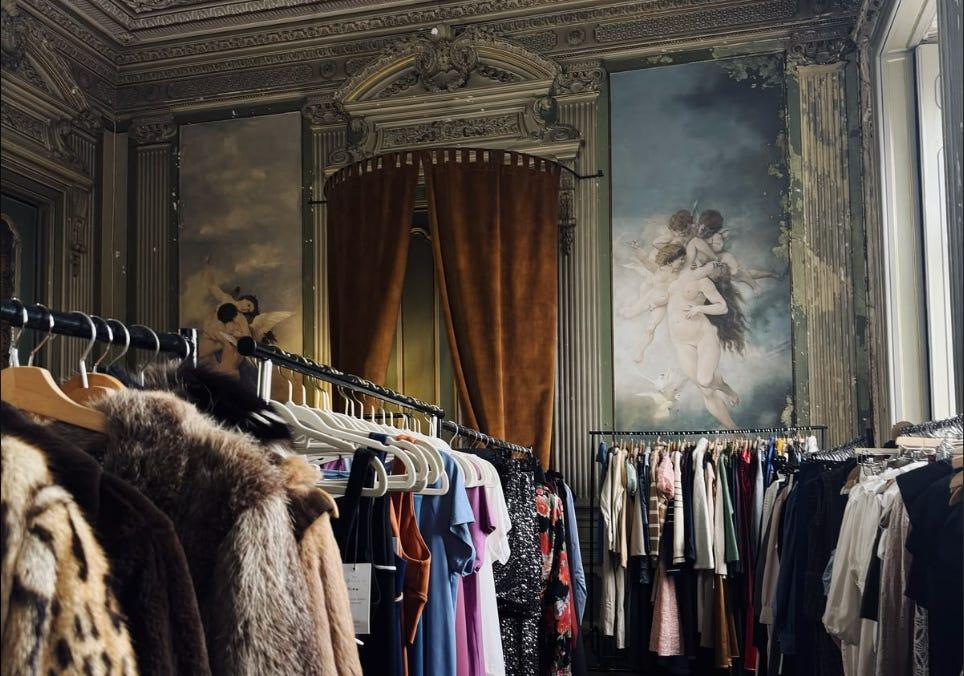
Last week I made the case for buying backwards: that the truest test of an eye for quality is being left alone with an object, no assistant and no campaign doing your thinking for you, and deciding for yourself whether it’s any good. Which leaves the obvious question. Where?
I’m not going to pretend London is a cheap place to dress well. It isn’t. The charity shops in the nicer postcodes price like boutiques now, the vintage dealers know exactly what they have, and if you’re hoping to wander in and find a hidden gem by pure luck, you’re probably about fifteen years too late.
What London has instead is supply. So much design happens here that the city gets first pick of everything falling out of the system: last season’s stock, the samples made during production, the runway pieces that only ever existed as one-offs, the review garments quietly cleared out of press offices twice a year. All of it has to go somewhere.
I didn’t understand how unusual that was until I went home and tried to shop the same way. Secondhand exists there, of course. What doesn’t exist is this: rails of luxury, in good condition, priced to move. The supply simply never arrived, because the wardrobes it would have to come from were never there in the first place.
There was also the other thing, which took me longer to notice. Growing up, buying your clothes from a secondhand shop was quietly looked down on. It meant your family didn’t have the money, and that was the end of the conversation. Never mind that it was the most sensible thing a parent could do, given that a child outgrows everything in a season anyway and nobody was getting their money back on a coat.
Hand-me-downs were another matter entirely. Bags arriving from a family friend whose daughter had shot up a size. Things going back out the same way. Nobody thought of that as secondhand. It was just what you did, and it was lovely, and half of what I wore as a child came to me that way.
Which is very funny to me now, because that is exactly the clear-out-your-wardrobe evening everyone has with their girlfriends. Same clothes, same logic, better branding.
So the bargain isn’t lying around waiting. But the volume passing through this city, and the condition it’s in when it passes, is genuinely unusual. What follows is where it lands. Addresses are at the bottom, so you can read this without a notebook.
The dress agencies: where good taste goes to be resold
A dress agency sells other people’s clothes on their behalf and takes a cut. Nothing is bought in, nothing is ordered, and the shop has almost no control over what arrives. Which means you aren’t really shopping the shop. You’re shopping the neighbourhood, and that single fact explains why they cluster where they do.
Which is why you start in Chelsea. Loop Generation on Draycott Avenue is the friendliest way in: beautifully curated, but at a price point that surprises people, Gucci and Prada hanging a rail away from Ganni. Ask the staff to pull for you. That’s the part everyone forgets a consignment shop offers, and it’s free.
The one I’d actually send you to first is nowhere near Chelsea. One Scoop Store on Stoke Newington Church Street sources rather than donates, which is to say the owner goes out and finds the pieces herself. That’s why the condition is consistent and the prices don’t behave like west London’s. Somebody at Who What Wear called it the fashion industry’s worst-kept secret, which is usually said about a place shortly before it stops being one.
A word of honesty about agencies generally. Consignment is a curated bargain. The quality is high, and the digging is done for you, and you pay a little for that convenience, which is why the next category exists.
The vintage rooms
If the dress agency sells last year, the vintage room sells decades when even ordinary clothes were made with more care. At that point, shopping isn't really about getting a bargain anymore. It's about learning what quality actually looks and feels like.
Circa Vintage, tucked away south of the river, is the pilgrimage. Actual vintage couture, Chanel and Dior and Ossie Clark, Victorian through to the 1990s. Go even if you aren’t buying. You are there to touch construction that simply isn’t made anymore: the hand-finishing, the weight of the cloth, the seams with fabric left in them to let out.
Then east, to Aro Archive in Shoreditch, which is three floors arranged more like a small exhibition than a shop. It specialises in the Japanese and Belgian designers, Yohji Yamamoto and Comme des Garçons among them, and if you care at all about how a garment is put together, this is the room to stand in. Those are the designers who made construction the entire point rather than something hidden under a logo.
The sample sale
This is the one most people never use, and it’s the closest London gets to couture at high-street prices.
A sample sale is where a brand offloads excess stock, production samples, and sometimes actual runway pieces, usually at between half and ninety per cent off, because the clothes are last-season or one-offs that have already done their job. London is unusually rich in them because the designers and their press offices are here, so the city gets the clear-outs first.
There is a catch. The good ones get busy, you queue, and the venues rarely have changing rooms, and go early. The first hour is the whole game.
Two venues do this year-round. The Music Room in Mayfair runs near-weekly designer sales, and The Box in Hackney hosts them constantly, including the occasional archive sale worth building a week around. But the real skill is tracking, because the best sample sales are deliberately low-key. They don't advertise much, and by the time one appears in a Google search, the best pieces are often gone. Two websites are worth bookmarking: Chicmi, which has the most complete calendar, and London On The Inside, which is more selective. Keep an eye on both and you'll rarely miss a good sale.
The charity shops, and the myth about them
Everyone will tell you to shop the charity shops in the wealthy neighbourhoods, on the logic that rich wardrobes go in and charity prices come out. Half of that is true. The wardrobes really do go in, and the selection in places like Notting Hill and Primrose Hill can be extraordinary: the Mary’s Living & Giving shops especially, where you’ll find labels you’d never see in a charity shop anywhere else in the country.
The prices are the bit nobody warns you about. Most vintage shops know exactly what their stock is worth. Some check resale prices, some have people whose job is to price it, and it shows. You’re often paying not much less than you would at a dress agency, sometimes the same, but with less choice and no returns.
So go for the selection, not the bargain. If it’s bargains you’re after, look in the charity shops nobody writes guides about, in neighbourhoods with no fashionable reputation, where a good coat is still just a good coat. Ganddee is useful for finding second-hand shops and charity shops across the city, especially those that haven’t become destinations yet.
And for the days you can’t leave the house
Vinted is the platform I use most. Nobody is curating it, plenty of sellers don't know what they have, and not everything is priced with the resale market in mind. Vestiaire Collective is different. It authenticates higher-value items before they're shipped, so it's the place to go when certainty matters. eBay sits somewhere in between. It's still one of the best places to find archive pieces and deadstock.
Then there’s Dotshop, which is the odd one out and worth knowing for that reason. It isn’t resale at all. It’s curated, vintage sitting on the same page as new, and it’s doing the opposite of everything else here. Vinted hands you a haystack and trusts your eye. Dotshop has already done the looking, and you’re paying for someone else’s.
Why any of this is worth the trouble
I want to be clear that none of this is really about saving money, though you will.
The whole apparatus of new retail is built to do your looking for you. To make the price vouch for the quality, the campaign vouch for the price, and the assistant vouch for all of it, so that you never have to develop the one skill that would let you judge for yourself. Buying backwards, in a city like this one, is a small refusal of that arrangement. You do the looking. You turn and check the article over. You decide.
One last thing, because I know most of you aren’t reading this from London. If you ever find yourself here, even for a few days, this is worth building an afternoon around. Not as a shopping trip particularly. As a way to see a city without queueing outside anything. And if you never make it over, the online half of this works from anywhere, which is where most of my own finds have come from anyway.
Which brings me to the part I’m actually writing this for. I want yours. The shop in your city that nobody writes about. The site you’ve been quietly gatekeeping. The charity shop two towns over where the pricing hasn’t caught up yet.
-AE.
Notes:
¹ Joy Montgomery, “This Is Instagram’s Coolest Secondhand Brand,” Who What Wear: https://www.whowhatwear.com/who-what-wear-curates-one-scoop-store
Dress agencies Loop Generation, Draycott Avenue, Chelsea One Scoop Store, Stoke Newington Church Street (closed Mon and Tue) Sign of the Times, Elystan Street, Chelsea, the grande dame of the category The Exchange, Gloucester Road, mother and daughter run, reliably reasonable
Vintage Circa Vintage, Lansdowne Way, SW8, ring ahead Aro Archive, French Place, Shoreditch Rellik, Golborne Road, serious archive, closed Mon Found & Vision, Portobello Road, founded by two stylists and a tailor Alfies Antique Market, Marylebone, dealers across several floors, closed Sun and Mon Blackout II, Covent Garden, measures and dates everything, so no guessing whether a 1950s waist will close
Sample sale venues The Music Room, Mayfair, near-weekly The Box, Hackney, year-round
Also worth knowing Ganddee maps secondhand and charity shops across the city, useful for finding the ones that nobody has written about. Kerry Taylor Auctions is the most well-known specialist fashion auction house. She has sold Audrey Hepburn’s clothes, Amy Winehouse’s, and ten of Princess Diana’s dresses. Mostly out of reach, but the catalogues are free and an education in themselves.
First published by Third Row Thinking on 24 July 2026.
Free newsletter
The NOOR Edit
Liked this? Get NOOR’s best stories by email.