
FASHION CHRONIC CONDITION
Luxury’s third-quarter results are in and Mimma Viglezio is not encouraged. Her diagnosis: fashion’s problem is no longer a bad season but a lasting condition.
This is the season of third-quarter results for the luxury groups that own the brands we follow, love or dislike; the same brands that fill my Instagram comments with thank-yous for ‘telling it as it is’, and, at times, insults for, once again, ‘telling it as it is’.
I’ve read all the reports by financial analysts, digested the press summaries and commentary available, and listened to some of my favourite commentators on Instagram. I can now officially tell you: it’s not good news.
No matter how big or small the percentages of growth or decline, or how the results compare across brands and groups, what is obvious today is that fashion brands are not as resilient as they once were. They suffer from economic downturns and uncertainty, like everything else, but on top of it I believe their disease is now chronic rather than temporary, and therefore not something that can be easily or quickly fixed.
Fashion is not trending. People are bored by the absence of exciting newness, outraged by prices that are only affordable to the ultra-rich, worried about their earnings and keener to spend their money on beauty products. L’Oréal’s results are evidence of this, showing 7.7% growth, fuelled by strong demand for hair and skincare products
CFOs and analysts cite slowing consumption in China and the wider economy, as the main reasons for stagnating results in fashion. And it is a fact that indulging in an expensive cream is still more affordable than buying luxury accessories or ready-to-wear.
Hermès, which obviously caters to the ultra-rich, is showing growth of 4.3% at constant exchange rates, with its main category, home of the favourite bags of the rich and famous, the Birkin and Kelly, growing by 10.8%. And even if Chanel as private company does not report its results, we have all witnessed the phenomenal success of its new collections and the obvious health of its sales.
The former demonstrates that the rich are getting richer and indulging in what only they can afford. The latter demonstrates that, regardless of the economy or fashion fatigue, when a brand excites, customers are willing to indulge, and not just the ultra-rich.
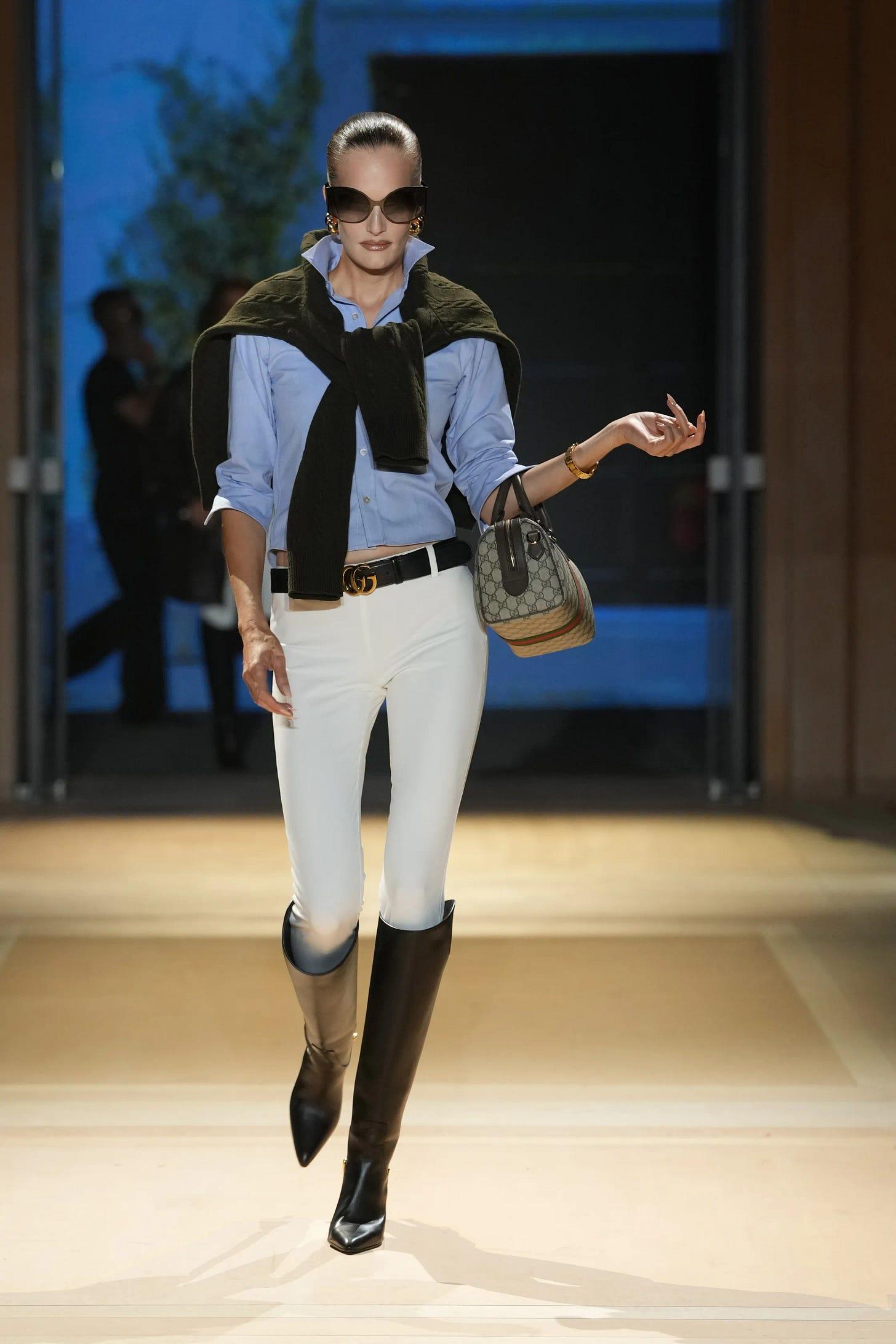
Which brings me to Kering and its star brand, Gucci. Despite the very weak environment and a low basis of comparison, Gucci performed worse than most, sending its parent company’s shares down by 12%.
Gucci’s revenues have fallen by more than 40% since 2022, and after a 2% dip in Q2 the quarter just gone slid back to -6%, exactly as the recovery was meant to take hold.
Francesca Bellettini, Gucci’s Chief Executive Officer, and Demna, its Creative Director, are under more pressure than ever.
Even if the collection presented this past September cannot be held responsible for the Q3 2026 results, it is obvious that Demna’s magic has yet to materialise. The excitement generated by the promise of newness, evident after his very first mini-collection, La Famiglia (for me, by far his best), has since waned.
I disagree with most of the press calling the latest SS27 collection a breakthrough. I suspect that, either because of their personal connections with Demna and a desire to support the magnitude of his effort, or because of their publications’ commercial interests, some felt compelled to praise it.
The collection undoubtedly presents many desirable and sellable clothes and accessories, but, given the low traffic Kering itself reports, I doubt that the Gucci mania we have witnessed in the past will happen. And that rush of interest is probably what Gucci desperately needs to bring revenues back up to the levels expected by the markets and shareholders.
Luca de Meo, Kering CEO, can hardly reshuffle Gucci’s leadership at this point, and as a consequence afford another year of waiting for a much-needed turnaround. Bellettini will therefore have to find a way to support Demna in delivering and create irresistible collections.
Perhaps Gucci and Demna are not the perfect fit, or perhaps it is simply the sheer magnitude of the task and the inevitable pressure; whatever the reason, so far, he has disappointed.
Gucci must urgently elevate desire around the brand to resume selling enough entry-level products to all those aspiring customers it has lost.
Time for Kering is running out.
First published by Mimma Viglezio on 24 October 2026.
Free newsletter
The NOOR Edit
Liked this? Get NOOR’s best stories by email.