
The Cannibalism of Google and Meta
AI answers are convenient for readers and less so for the websites they are built from. Judy Yamakawa on a search business that may be eating the ecosystem that feeds it.

Google is currently facing the innovator’s dilemma. And somewhere in the machinery of the world’s most powerful information businesses, a rather extraordinary snake has begun to eat its own tail.
For decades, Google’s business model was beautifully simple. People wanted information. Google helped them find it. Advertisers paid quite handsomely to appear at the top of search results, and, equally, publishers received visitors who converted into advertising revenue, subscriptions and customers. The capitalism full English breakfast, at large. The baked beauty of Google was in becoming indispensable to finding information. How many other companies have become a noun in most modern languages?
…Then came generative artificial intelligence.
Google’s AI Overviews and AI Mode increasingly offer answers directly within the search experience. They are more palatable than Marmite, and as popular for the lazy mind as giving toddlers beige toys. Instead of presenting ten blue links and allowing the user to investigate, a response is assembled, not unlike the creation of Frankenstein, from information found elsewhere. Is this convenient for the user? Most certainly. Although less obviously convenient for the websites whose material makes those answers possible.
If you are a publisher watching your webpage traffic plummet, my condolences for the change to the menu.
Google continues to index content produced by publishers and businesses. Whilst publishers still largely rely on Google traffic to generate advertising and subscription revenue, fewer people may click through to the original websites. Ergo, publishers may earn less and have less incentive to invest in their own original content. This is an information ecosystem Google championed, one on which its search and AI products depend, that now risks being poisoned by its own patron.
Perhaps our rainbow snake is not swallowing itself - yet. But it certainly is chewing on the ecosystem that feeds it.
Now there is a second, more immediate problem on our prickly horizon: Google’s AI answers may reduce the number or commercial value of traditional search advertising opportunities. What is advertising when it is worth less?
The $500 Billion Bite
But, let’s not get too carried away. Let us distinguish this theoretical risk from what Alphabet’s financial results truly show.
On 29th October, Alphabet suffered a historic stock-market sell-off, wiping approximately $500 billion from its market valuation in a single day. That is an extraordinary amount of shareholder value to disappear. It is not, however, the equivalent of Google losing $500 billion in revenue or spending that amount in cash.
Indeed, the company’s underlying financial results tell a rather different story.
Alphabet reported third-quarter revenue of $127.6 billion, an increase of 25% year on year. Google Search and related advertising revenue increased by 12%. The business is not shrinking. Quite the opposite.
And yet, hastily tucked inside these impressive figures is a warning.
Google’s Chief Business Officer, Philipp Schindler, acknowledged during the company’s third-quarter earnings call that the rapid growth of AI Mode queries had contributed to slower Search advertising revenue growth, owing to their lower monetisation compared with conventional searches.
This is where our ouroboros forms. An ancient symbol of a serpent devouring its own tail, the ouroboros represents the eternal cycle of creation and destruction. In Google’s case, the symbolism is rather apt. The nibbling of a tail.
Google is encouraging adoption of a product that currently monetises less effectively than its established search engine. Simultaneously. Why?
Imagine we have 100 million traditional searches generating an average of ten pence in advertising revenue each. That produces £10 million for us. Now, imagine the same number of searches conducted through an AI interface, generating just four pence each. Revenue collapses to £4 million, despite the same volume of activity. I am giving figures that are illustrative, as Google’s rates are not publicly disclosed. But I hope the principle is conveyed.
Google may serve the same number of searches in AI Mode, but doing so may result in higher AI-computing costs and substantially less advertising revenue. Advertisers have not necessarily reduced their budgets. Google may simply be less effective at monetising their attention through the new interface. The company is therefore confronting an uncomfortable possibility: technological improvement does not automatically translate into commercial improvement.
Why Would Google Cannibalise Itself?
Google may have little choice.
If it does not provide AI-generated answers, users could be drawn to migrate to ChatGPT, Claude or other AI services. Google currently faces two competing risks: cannibalise itself by introducing AI products that weaken its established advertising economics, or allow disruption by protecting traditional search whilst losing users to competitors offering better AI experiences.
This is the innovator’s dilemma in unusually resplendent form.
A successful company becomes so effective at serving an established market that a new technology threatens the very economics responsible for its success. The company must either defend the old model or undermine it before somebody else does.
For Google, the answer appears to be to pursue both strategies at once. Google is simultaneously trying to replace the way people discover information, preserve the advertising revenue generated by that discovery, and maintain the publishers whose content makes discovery valuable. Those objectives may increasingly conflict.
The important question is whether Google can invent a new advertising model that makes AI search more profitable before it undermines the economics of the old one.
And that brings us to Meta. Whilst Google is wrestling with the possibility of cannibalising its own product, Meta is facing a different accusation altogether, in that it may be extracting too much from the businesses whose participation makes its platforms valuable.
Meta Slithers In: A Different Appetite
A day after Alphabet’s peckish moment, Britain’s Competition and Markets Authority (CMA) announced an investigation into Meta’s commercial terms for publishers, advertisers and other businesses using its platforms.
The controversy began earlier in October, when Meta, parent company to triplets Facebook, Instagram and WhatsApp, notified businesses of proposed changes to its commercial terms. These changes raised concerns that Meta could collect content from publishers’ and businesses’ websites to develop its own products and services, including training artificial intelligence systems, without obtaining meaningful consent or providing compensation.
The changes were originally scheduled to take effect on 30th October, before being postponed to 20th November following industry opposition. Meta has since suspended their introduction indefinitely, pending consultation.
The Movement for an Open Web, whose members include advertisers and publishers, complained to both the CMA and the European Commission. The central concern is whether Meta is using its dominant commercial position to impose conditions that businesses have little practical ability to refuse.
Sarah Cardell, Chief Executive of the CMA, has publicly warned that a company holding a dominant position must not use that position to impose unfair terms. The News Media Association’s Chief Executive, Theo Bamber, has also characterised Meta’s proposals as a “shameless land grab”, warning that they could allow Meta to scrape content from news publishers and business websites.
Meta disputes the criticism. It maintains that there are no grounds for a competition investigation and has committed to consulting publishers and other stakeholders before changing its terms. The proposed changes have been paused, and the CMA has not determined that Meta has broken the law. Nevertheless, the investigation exposes a fascinating tension within the modern information economy.
Imagine a newspaper employing journalists to investigate a major financial scandal. It pays their salaries, funds their research, verifies their findings and publishes the resulting investigation. The newspaper then uses Facebook and Instagram (Meta products) to distribute its work, attract readers and generate commercial returns. This is a standard funnel of affairs for a modern newspaper.
But now imagine that the platform distributing the investigation also wants broad permission to collect and use the newspaper’s content for its own commercial development.
Who, precisely, is creating the value? And who is entitled to capture it?
A publisher may theoretically be free to reject a platform’s commercial terms. But what happens when rejecting those terms also means losing access to an audience that has become essential to the publisher’s business? Consent becomes a rather complicated concept when the alternative is commercial exclusion.
The Two Forms of Cannibalisation
Here is where Alphabet and Meta begin to diverge.
We can define Google as the snake that primarily monetises intention. A user searches for a product, service or answer, and advertisers pay to reach that person at the moment of expressed interest.
Meta is the snake that primarily monetises attention. A user scrolls through Instagram, watches videos, follows friends and discovers content (as Gen Z, I vaguely acknowledge that Facebook follows a similar system). Meta’s advertising systems predict what that user might be interested in purchasing, often before the user has consciously decided to look for it.
This period of change threatens these business models in distinctly different ways.
For Google, AI can replace some of the traditional interactions through which search advertising generates revenue. For Meta, AI can improve recommendation systems, advertising targeting, creative production and engagement. Better predictions may mean more relevant advertisements and greater revenue from the same audience. To enunciate in another form: Google risks making part of its existing product less profitable, whilst Meta may make its existing product more profitable.
Uniquely, Meta has its own vulnerability. Its commercial strength is dependent upon millions of businesses, advertisers, publishers and creators continuing to find value in participating in its platforms. So, if the cost of participation becomes excessive, or the benefits of participation diminish, those businesses may eventually reduce their investment.
Consider a fashion house that spends thousands of pounds developing original photography, product descriptions, creative campaigns, etc. The fashion house then pays Meta to reach potential customers. If Meta can also acquire broad rights to use that business’s intellectual output to improve its own commercial systems, the relationship begins to look rather rotten. The fashion house is no longer merely committing to buying distribution; it may also find itself supplying an input into the platform’s future technological advantage.
We therefore have two forms of cannibalisation. Alphabet faces product cannibalisation: AI Mode may substitute a new, potentially less profitable search experience for the traditional one. Meta faces the possibility of ecosystem cannibalisation: more extensive content use, higher advertising costs or reduced returns for businesses could weaken the incentives of commercial participants to invest in the platform. The distinction matters because a company can preserve, or even improve, the profitability of its own products whilst gradually eroding the commercial foundations of the ecosystem that sustains them.
The former is already visible in the economics of AI search. The latter remains a longer-term risk, rather than an established outcome. And yet both point towards the same underlying problem.
Who Feeds the Machine?
The emerging AI-mediated model has forced an awkward and significant shift in the commercial relationship between those who produce information and those who distribute it. Where the traditional internet offered publishers at least the prospect of receiving visitors in exchange for making their content discoverable, AI systems can now process that content and satisfy a user’s enquiry without directing them to its original source. The exchange has not merely become less generous; in some circumstances, the return journey has disappeared altogether.
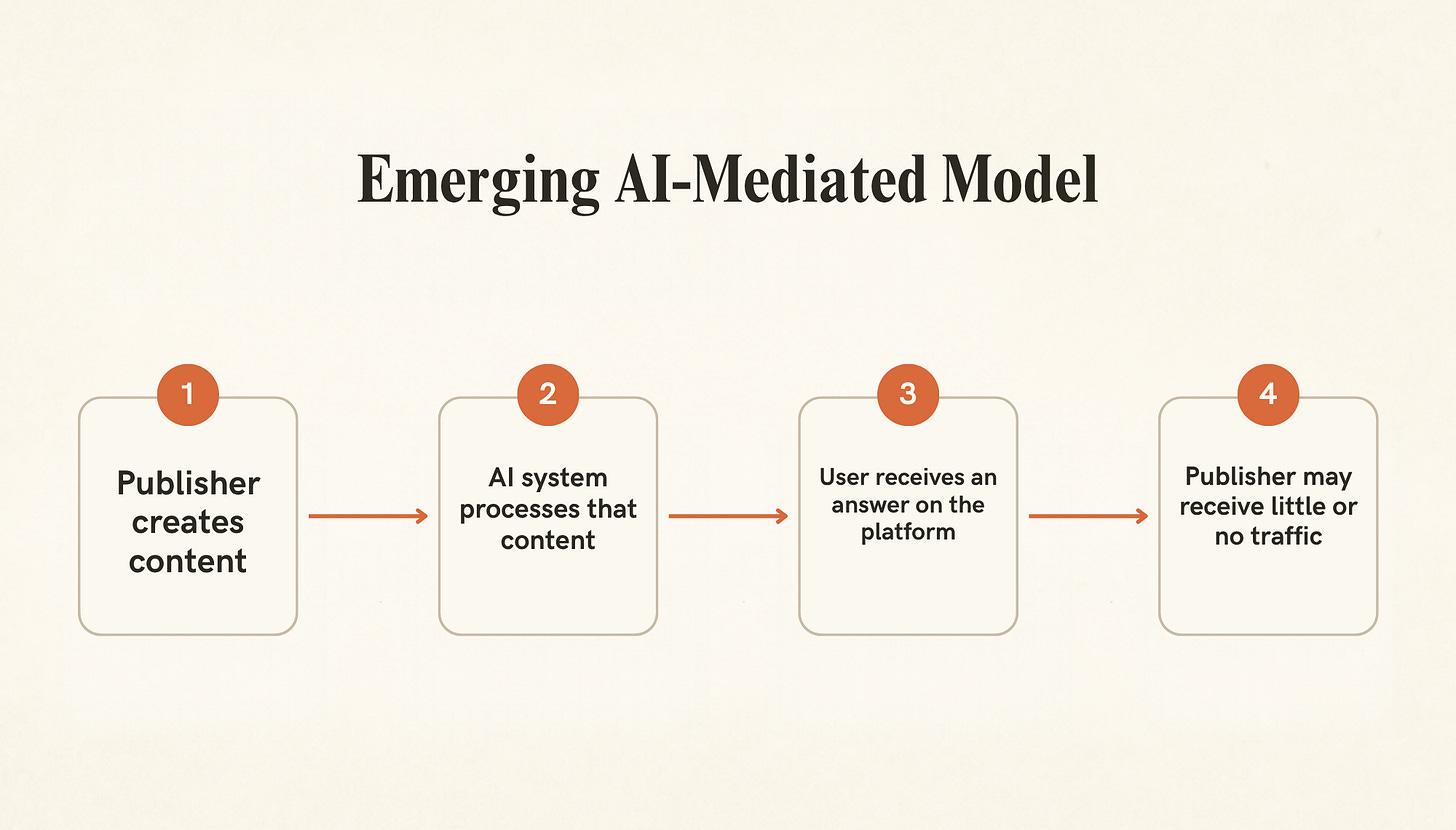
And so, we find ourselves in a rather uncomfortable possibility.
The businesses financing the production of knowledge may become economically weaker as the businesses processing that knowledge become stronger. Indeed, in the long term, if original reporting, specialist research and investigative journalism become less profitable, who will see the value of financing the next generation of information on which AI systems depend? This is not simply a question of whether AI companies should pay for training data. It is a question of whether the economic incentives sustaining original information production can survive a fundamental change in how that information is consumed.
Of course, the argument is not entirely one-sided. Meta does legitimately counter that the changes it has announced do not give it new rights to override publishers’ preferences. Website owners may communicate crawling preferences through robots.txt (and if you haven’t already, it is worth investigating…then come back and finish this article). Such instructions, however, do not guarantee that every crawler will comply, nor do they necessarily resolve questions of commercial consent. There is a critical distinction between communicating a technical preference and possessing an enforceable contractual right to refuse commercial use.
The current conundrum is whether reading and learning from published information is fundamentally different when a machine does it instead of a human. Copyright generally protects expression rather than facts or ideas. AI systems, on the other hand, operate at a grand scale with commercial consequences that challenge traditional distinctions. A human journalist might read twenty articles and produce an original analysis. An AI system might process millions of articles and generate responses for millions of users. Both involve learning from existing information; however, the scale, substitutability and commercial consequences differ enormously.
There is also the opposite danger. If every use of information required expensive licensing arrangements, the largest AI companies might be the only organisations capable of affording them. Regulation intended to protect publishers could inadvertently strengthen the very platforms it seeks to constrain.
Like waiting for news at a GP appointment, there is no particularly comfortable answer.
The Lip-Biting Worry
Our current emerging structure of the information economy is increasingly concentrated around three groups: those who produce information, those who control the infrastructure through which it is processed and distributed, and those who consume it.
The middle layer is accumulating disproportionate economic and informational power. These same platforms can increasingly act as distributors, competitors and potential consumers of the intellectual output of the businesses that depend on them. This has implications beyond publishers, naturally. Scientific research, educational material, specialist databases and even individual creators building audiences on Instagram are exposed to similar questions about ownership, access and commercial value.
We are moving from an economy in which owning information creates value to one in which controlling access to information captures the value… Or at least, that is the direction in which the incentives appear to be moving.
I am not placing myself in a position to argue that original information will become worthless. As a curator of international art and fashion exhibitions, I have seen quite the contrary across multiple disciplines, as creatives are able to claim new audiences hungry for evidence of ‘the human touch’. More broadly, across industries, as synthetic content becomes increasingly abundant, genuinely original research, trusted reporting and proprietary knowledge may become more valuable. Isn’t it interesting how scarcity has a habit of reasserting itself where abundance becomes overwhelming?
Yet there is a peculiar paradox here. The greater the abundance of synthetic information, the more valuable genuinely original work may become. But an increase in the value of originality does not necessarily mean that its creators will be the ones to profit. The scarcity may belong to the artist, journalist or researcher, whilst the means of discovering, distributing and monetising that scarcity remain in somebody else’s hands.
Note that value and bargaining power are not the same thing. A publisher may possess extraordinarily valuable information and still struggle to monetise it if the principal route to its audience is controlled by somebody else. Likewise, an advertiser may benefit from Meta’s increasingly sophisticated targeting systems. This will not protect it from becoming highly dependent on the very platform whose algorithms establish the cost of reaching its customers. The danger here is not that the middle layer creates no value. Indeed, Google and Meta create enormous value through discovery, distribution, infrastructure and convenience. We need to ask whether the balance between value created and value captured is going to become increasingly impossible to sustain.
The Ouroboros Returns
There is something almost indulgently mythological about the position in which these companies find themselves.
Google has built a search empire so successful that it must now risk undermining its own advertising model to defend that empire against AI-native competitors. Meta, meanwhile, is attempting to strengthen its commercial and technological position through the same information economy on which publishers and advertisers depend, while facing regulatory scrutiny over the terms of that relationship. Neither company is necessarily heading towards collapse. Both have enormous resources, sophisticated engineering capabilities and opportunities to develop new commercial models.
But the underlying tension is difficult to ignore.
We do not need to fret that advertising will is die. That is a grandiose statement even for a Substack article. What we are really witnessing is the economic value of attention being redistributed, and the platforms controlling AI interfaces may capture more of that value than the people creating the underlying information. This is both a fascinating phenomenon and a broad concern. Google’s emerging problem is that its new technology may undermine the economics of its old technology. Meta’s potential problem is that extracting greater value from its ecosystem may eventually undermine the willingness or ability of others to contribute to it (ultimately, my bet is on the latter being a more powerful determinant).
One is eating its own tail. The other may be eating from somebody else’s plate.
And perhaps that is the more interesting question. Who really needs to worry their brow over whether AI will make information cheaper, faster or more accessible? It almost certainly will. We should be asking whether the businesses that profit most from making information accessible will preserve sufficient incentives for somebody else to keep producing it.
After all, even an ouroboros needs something to eat.
First published by Judy Yamakawa on 1 November 2026.
Free newsletter
The NOOR Edit
Liked this? Get NOOR’s best stories by email.